Fit and Well Logo

Our Policies About Us Contact Us

Home > Diet & Food > Healthy Eating >
Grapefruit Factsheet - Benefits

Grapefruit Factsheet - Benefits

Health Benefits of adding Grapefruit to your diet

By | Updated .

checked symbolFact Checked

Fact Checked

×

All the content published in our website is fact checked to validate its accuracy.
Visit our guidelines web page to learn more about our strict processes regarding how we review our content's sources: reliable and reputable journals, media websites, universities, colleges, organizations, and professionals.
Our articles are based on scientific evidence, and the references are included in their footnotes, which are clickable links to sound scientific papers.

First published: 09.Jan.2026

Overview

Grapefruit is a citric fruit that has been considered a key ingredient in a healthy diet. It is rich in minerals, vitamins, fiber, and phytochemicals like flavonoids and furanocoumarins. These bioactive compounds provide health benefits due to their antioxidant, antimicrobial, and anti-cancer properties.

Grapefruit helps manage weight, metabolic syndrome, lower blood lipid levels, reduce high blood pressure, and enhance bone health.

This article will explore the health benefits, the adverse effects, and how to include grapefruit in your diet.

In this Article (Index)

two half grapefruits
Healthy grapefruit. A. Whittall

Grapefruit

The grapefruit is a member of the Rutaceae family, which also includes several edible citrus, such as oranges, lemons, lime, kumquats, and mandarins.

The scientific name given to grapefruit is Citrus × paradisi. The '×' symbol indicates that it is a hybrid of two different citric plants, pummelo (Citrus maxima) and sweet orange (Citrus sinensis).

Hybridization is the crossing of two genetically different species or varieties, which produces an offspring, called a hybrid, with traits from both parents.

The grapefruit is believed to have originated in Barbados, an island in the Caribbean, where it spread across the West Indies Islands in the early 1700s. The first record of it is found on Hans Sloane's catalog of Jamaican plants of 1693.

The name: Grapefruit

It was first recorded in 1814 and probably refers to the fact that it grows in clusters like grapes. During the 1700s, it was known as shaddock after Captain Shaddock from the East India Company who introduced the seeds of this fruit to Barbados. Another name was pomelo, which comes from the Dutch word pompelmous, a combination of pompel = "big", and limoes = "lemons".

It was originally used as a decorative plant, but by the end of the 19th century, it was adopted as an edible fruit.

Varieties

The original strain was the white-yellow variant, but natural mutations with a pink or reddish tone were detected and selected by producers creating the popular pink and red varieties.

There are currently three major types of grapfruit on the market: white, pink+red and ruby+rio red.

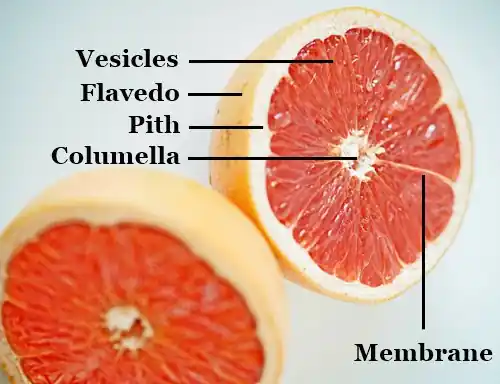
The main parts of a greapefruit

These are the main parts of this fruit:

Flavedo

The skin is pigmented, and has a tone that ranges from yellow to red. It contains essential oils that give the fruit its characteristic aroma.

If you intend to use the skin for zest, to give a tangy taste to your dishes, you should remove the wax. To preserve moisture, all citrus, including grapefruit are coated with a thin layer of wax with a formulation that is approved by the Food and Drug Administration (FDA). In the case of organic fruits, the wax is vegan (a derivative of palm oil). To remove the wax, use a brush and clean, hot, running water.

Pith

Beneath the flavedo is a spongy, white layer known as pith or albedo. It is bitter because it has high levels of a compound called naringin. It is very rich in pectin, a viscous fiber, which can help lower the LDL or "bad" cholesterol levels(1). It also acts as a prebiotic, promoting gut health.(2)

The pith's pectin is a natural gelling agent for grapefruit marmalades.

As naringin is water soluble, the pith loses its bitterness when it is blanched (briefly boiling). It can be used in smoothies, teas, and candied peel. It is rich in Vitamin C, and phytochemicals. However, blanching removes bitterness and also the bioactive naringin.

Collumella

The white central axis of the fruit. Tough, its properties are similar to those of the pith.

Membranes

These tough walls radiate from the collumella towards the pith. They form wedge-shaped segments containing the flesh of the fruit. They are edible and share the pith's benefits.

Vesicles

The fleshy edible tissue is contained in small teardrop-shaped vesicles. These vesicles contain the juice, the flavor, the sugary-acid taste. They are rich in the pigments that color the fruit (yellow, pink, or deep red).

grapefruit cut in half with names of its components
The parts that makeup a grapefruit. A. Whittall

Nutritional Values of Grapefruit

Below we list the nutrients, minerals, vitamins, other compounds, and energy content in 100 g (3.5 oz.) of grapefruit according to the USDA(3)

Nutritional Values

Item

Value

Water

88.06 g

Energy

42 kcal

Protein

0.77 g

Carbohydrates

10.66 g

Dietary Fiber

1.6 g

Total Sugars

6.89 g

Total Lipid (fats)

0.14 g

Vitamins

In mg unless specified otherwise specified

Item

Value

Vit. C

31.2

Vit. A (IU)

58 μg

Niacin (B3)

0.204

Thiamine (B1)

0.043

Riboflavin (B2)

0.031

Pyridoxine (B6)

0.053

Folate, total (B9)

13 μg

α-tocopherol (E)

0.13

Grapefruit has no detectable levels of Vitamin D or Vitamin K.
But pink and red grapefruit are good sources of beta carotene (a source of vitamin A).

Minerals

The following shows the mineral content in grapefruit expressed in mg per 100 grams unless otherwise specified.

Item

Value

Sodium (Na)

0

Magnesium (Mg)

9.0

Potassium (K)

135.0

Calcium (Ca)

22

Copper (Cu)

0.032

Zinc (Zn)

0.07

Iron (Fe)

0.08

Phosphorous (P)

18

Selenium (Se)

0.1 μg

Other compounds

In micrograms (μg) unless otherwise specified.

Item

Value

Choline

7.7 mg

β carotene

686

α carotene

3

β Cryptoxanthin

6

Lycopene

1,419

Lutein + zeaxanthin

5

Grapefruit, particularly red and pink varieties, contain very high levels of Lycopene and β-carotene. One cup of red or pink grapefruit flesh has as much lycopene as a medium 110 g tomato (4 oz.) Lycopene has been associated with a lower risk of certain cancers and better cardiovascular health.

Phytochemicals

Like all plant-based foods, grapefruits contain phytochemicals (phyto = plant). These are bioactive compounds that have a positive health-promoting effect.

Furanocoumarins

Thee derive from a compound known as psoralen, which is found in all citrus fruits, figs, celery, and parsley.

There are several furanocoumarins in grapefruit. These are bergaptol, bergapten, bergamottin, and epoxybergamottin.

Furanocoumarins have antioxidant, anti-inflammatory, and also anti-cancer effects.

Flavonoids and Limonoids

Grapefruit contains flavonoids, which are polyphenolic compounds, and limonoids (tetranortriterpenoids), which have identical beneficial health properties (learn more about Flavonoids).

They are anti-inflammatory, antioxidants, and display anti-cancer effects.

Naringin

Hesperidin and naringin are the main grapefruit flavonoids, with potent anti-cancer effects. More on these anti-cancer properties below.(4)

Most of the grapefruit's naringin is found in the flavedo, pith, and membranes. See the following table with naringin content in ppm for Texas grapefruit.(5)

Item

Value

Flavedo

4,100-54,500

Membrane

14,900-53,500

Pith

6,800-30,700

Collumella

7,400-54,200

Juice

130-1,300

Health Benefits

Anti-cancer effects

The naringin and hesperidin content in grapefruit (GF) are responsible for its anti-cancer effects. They have been shown to delay the development of leukemia and breast cancer. Bergamottin (another furanocoumarin found in GF) inhibits the growth of breast cancer cells. Bergaptol and bergapten, found in GF, also inhibit breast cancer cell growth and may trigger the death of tumor cells.(4)

Weight Loss, Metabolic Syndrome

A very common popular belief is that grapefruit "burns" fat, which is false. However, there is some evidence that supports grapefruit's weight loss effects.

Obesity and metabolic syndrome are linked; high glucose levels in blood and insulin resistance are frequent in obese people. A study by Fujioka, Greenway, Sheard, and Ying (2006)(6) explored the effects of grapefruit on body weight and metabolic syndrome.

Their randomized study split 91 obese subjects into a control group and experimental groups. The control group consumed placebo capsules and 7 ounces (207 ml) of apple juice. The experimental groups consumed either: (1) grapefruit (GF) capsules with 7 ounces (207 mL) of apple juice, (2) 8 ounces (237 mL) of grapefruit juice with a placebo capsule, or (3) half a fresh grapefruit with a placebo capsule. These were taken three times a day before each meal.

The GF groups lost significant weight over the 12-week study: 1.6 kg (3.5 lbs) in the fresh GF group, 1.5 kg (3.3 lbs) in the GF juice group, and 1.1 kg (2.4 lbs)in the GF capsule group. The control group only lost 0.3 kg (0.66 lbs).

The weight loss induced by GF (fresh, juice, or capsules) was significantly greater in the subjects with metabolic syndrome.

GF intake also lowered insulin levels in the GF group compared with the placebo.

Half of a fresh grapefruit eaten before meals was associated with significant weight loss. In metabolic syndrome patients the effect was also seen with grapefruit products. Insulin resistance was improved with fresh grapefruit. Although the mechanism of this weight loss is unknown it would appear reasonable to include grapefruit in a weight reduction diet. Fujioka, Greenway, Sheard, and Ying (2006)(6)

Another randomized trial by Dow, Going, Chow, Patil, and Thomson (2012)(7) explored the role of grapefr,uit on body weight and blood pressure with a group of 74 overweight adults who either ate a control diet or a daily grapefruit diet, with one half of a fresh Rio-Red grapefruit with each meal (3× daily) for 6 weeks.

Surprisingly, "no differences between groups in weight, blood pressure, or lipids were demonstrated."

Only a modest weight loss was linked to eating grapefruit (0.61 kg or 1.34 lbs).

Lower cholesterol, blood pressure and waist circumference

However, the study found that eating GF helped reduce waist circumference significantly, by 2.45 cm (1 inch), it caused a "a significant reduction in systolic blood pressure (-3.21 ± 10.13 mm Hg) compared with baseline values."

Grapefruit intake improved blood lipid levels, decreasing total cholesterol, "bad" LDL cholesterol values significantly vs. baseline levels.

This study suggests that consumption of grapefruit daily for 6 weeks does not significantly decrease body weight, lipids, or blood pressure as compared with the control condition. However, the improvements in blood pressure and lipids demonstrated in the intervention group suggest that grapefruit should be further evaluated in the context of obesity and cardiovascular disease prevention.Dow, Going, Chow, Patil, and Thomson (2012)(7)

Grapefruit improves Diet Quality and Health

A study by Murphy, Barraj and Ramersaud (2014)(8), evaluated the effects of consuming grapefruit and a set of health parameters. It used data from the 2003-2008 National Health and Nutrition Examination Survey (NHANES). Anyone consuming grapefruit (GF) or 100% grapefruit juice at least 50% of the days of dietary recall was classified as a grapefruit consumer.

Only 2.5% of men and 2.7% of women out of the total sample size of 12,789 individuals were regular GF consumers. These people had a significantly higher intake of Vitamin C, potassium, magnesium and dietary fiber, as well as β-carotene.

They had a higher diet quality score assessed by the Healthy Eating Index-2005 (HEI-2005) than those who did not consume grapefruit.

In women, consuming GF was "associated with lower body weight, waist circumference, body mass index (BMI), triglycerides, C-reactive protein (CRP), and higher high-density lipoprotein (HDL) cholesterol. However, the risk of being overweight/obese was not associated with grapefruit consumption."

Most adult Americans don't meet the recommended levels of fruit intake.

Grapefruit is a good source of nutrients. One-half medium-sized grapefruit (approx. 150 g) provides 100% of the daily recommended intake or DV, of Vitamin C, 35% of the DV for Vitamin A, 8% for dietary fiber, 5% for potassium, and less than 5% for other minerals and compounds (calcium, magnesium, vitamin B6, thiamin, niacin, folate).

Improves Blood Lipids Levels

Gorinstein et al., (2006)(9) studied a group of 57 patients with high blood lipid levels (a condition known as hypertriglyceridemia), ages 39 to 72 years, who had undergone coronary bypass surgery. They were split into two groups receiving red or white (blond) grapefruit (GF), and a control group. The test lasted 30 days. Blood lipid levels were measured before and after the trial.

Blood serum lipids decreased in both grapefruit groups in comparison with the control group: total cholesterol by 15.5% (red GF) and 7.6% (white GF), LDL or "bad" cholesterol fell by 20.3% (red GF) and 10.7% (white GF), and triglycerides dropped by 17.2% (red GF) and 5.6% (white GF). The control group's blood lipids remained unchanged during the study.

The authors found that "red grapefruit has a higher content of bioactive compounds and a higher antioxidant potential than blond grapefruit"

In conclusion, fresh red grapefruit contains higher quantities of bioactive compounds and has significantly higher antioxidant potential than blond grapefruit. Diet supplemented with fresh red grapefruit positively influences serum lipid levels of all fractions, especially serum triglycerides, and also serum antioxidant activity. The addition of fresh red grapefruit to generally accepted diets could be beneficial for hyperlipidemic, especially hypertriglyceridemic, patients suffering from coronary atherosclerosis. Gorinstein et al., (2006)(9)

Cardioprotective effects (Blood Pressure)

Further up we mentioned a randomized trial that found that eating fresh grapefruit helped lower cholesterol levels and blood pressure. Below is more evidence of the heart-protective effects of grapefruit.

Krga et al, (2022)(10) studied the effects of the flavanones in grapefruit juice on cardiovascular disease (CVD). The randomized trial compared a group of women who drank grapefruit juice with a control group that drank a flavanone-free drink for six months. They found that the flavanones in grapefruit juice improved immune response, lowering inflammation. Flavanones also changed gene expression in a positive way, as it was associated with lower arterial stiffness and blood pressure. This suggests that the flavanones in grapefruit, like naringin and narirutin, have a cardiovascular protective effect. Previous studies by the same team had also shown that these flavanones reduced atherosclerotic plaque and improved cholesterol levels.

The results of this study suggest that regular consumption of flavanone in grapefruit juice could modulate the expression of genes that could contribute to the prevention of vascular dysfunction and, consequently, the development of CVD. Krga, I., et al. (2022) (10)

Bone Health

Different studies have found that naringin improves bone mineral content, and it has bone-preserving (anti-osteoclastic) and bone-growth-promoting (osteogenic) effects. Cui, Y., Yang, Z., Yu, G. et al. (2025)(11) reported that naringin "enhances bone density in mice and promotes osteogenic differentiation." This means that it promotes the growth of stem cells into specialized bone-forming cells known as osteoblasts. It also improved bone mineral density and trabecular bone number in mince. The trabecular bone number is an indicator of stronger bone with more struts or plates forming the bone matrix. Narginin also reduced a chemical marker (CYX-1) that signals bone resorption.

Another study by Zhou et al., (2022)(12) reported that naringenin can act as a potential anabolic treatment for pathological bone loss, acting upon osteogenesis and inhibiting the growth of bone-resorbing cells called osteoclasts.

Add Grapefruit to your diet

Bitterness has been an obstacle in popularizing grapefruit. Choose wisely. Red grapefruit are the least bitter, then come the pink varieties. White grapefruit is the most bitter.

Eat the fruit, straight

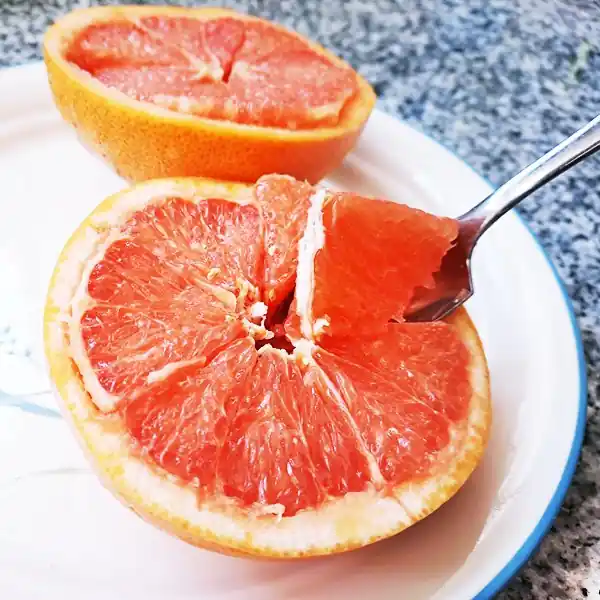
Cut a grapefruit in half, around the equator, slice each segment along the membrane, then cut along the edge of the pith, and eat it with a spoon.

You can also peel it like an orange and cut it into segments. Make sure you include pith; it is a good source of phytochemicals.

Don't add sugar! Added sugars are bad for your health. Nowadays, grapefruit is less bitter than it used to be. Selective breeding has focused on sweeter and redder varieties, alas, with less naringin (the bitter compound in grapefruit). This makes them more palatable.

Some Enticing Dishes

Slice it and add it to a fruit salad. The sweetness of other fruits will balance the bitterness of grapefruit.

Combine it with oranges for a healthy, bitter-sweet experience.

Add grapefruit segments to a green salad. Try adding pomegranate. The citric flavors will enhance the salad.

Prawns, avocado, hearts of palm, and grapefruit pair well! A fresh, zesty summer salad.

Grapefruit juice, freshly pressed. Combine with limes, lemons, oranges or pomegranate.

Adverse Effects and Interaction with Medication
Grapefruit and grapefruit juice can alter the way your body processes medications. They can increase the drug levels in your body, and this could increase their toxicity. They can also lower the absorption of drugs, making them less effective.

This means that they can provoke serious side effects, even with one portion of grapefruit. These effects can last for several days.

You should consult your healthcare provider, especially if pregnant, nursing, or on medications, before consuming grapefruit. Because something is natural, like grapefruit, it doesn't mean it's safe; grapefruit can interact with drugs or have strong effects. Be aware of any potential adverse reactions with your specific prescription or over-the-counter drugs. You may need to avoid GF.

Side Effects: Take-home point

Ask your healthcare provider the following questions:

  • Is your specific drug affected by grapefruit
  • How much, if any, grapefruit or grapefruit juice you can have.
  • What other fruits or juices may also affect your drug in a similar way to grapefruit juice.

The Food and Drug Administration (13) provides a list of some potential drugs that can interact with grapefruit (the list is not exhaustive):

  • Some statin drugs, which lower cholesterol, such as Zocor (simvastatin) and Lipitor (atorvastatin).
  • Some drugs for high blood pressure based on nifedipine, like Procardia and Adalat CC.
  • Immunosuppressing drugs (to prevent organ-transplant rejection) based on cyclosporine, such as Neoral and Sandimmune.
  • Anti-anxiety drugs like BuSpar (buspirone).
  • Corticoids for treating Crohn's disease or ulcerative colitis with budesonide (like Entocort EC and Uceris tablet).
  • Some drugs used for irregular heartbeat, based on amiodarone, like Pacerone and Cordarone tablets.
  • Antihistamines for allergies, with fexofenadine, like Allegra.

Grapefruit and its juice may not affect all drugs within the categories listed above. The effects also depend on each person, the drug, and the intake of GF.

Closing Comments

Grapefruit is a good source of Vitamin C, dietary fiber, and is rich in potassium. It has proven health benefits ranging from weight loss and cardiovascular health to stronger bones and anti-cancer effects. Add more grapefruit to your diet.

References and Further Reading

(1) Brouns F, Theuwissen E, Adam A, Bell M, Berger A, Mensink RP, (2011). Cholesterol-lowering properties of different pectin types in mildly hyper-cholesterolemic men and women. Eur J Clin Nutr. 2012 May;66(5):591-9. doi: 10.1038/ejcn.2011.208. Epub 2011 Dec 21. PMID: 22190137

(2) Foti P, Ballistreri G, Timpanaro N, Rapisarda P, Romeo FV., (2021). Prebiotic effects of citrus pectic oligosaccharides. Nat Prod Res. 2022 Jun;36(12):3173-3176. doi: 10.1080/14786419.2021.1948845. Epub 2021 Jul 6. PMID: 34227455.

(3) USDA, Food Details. Grapefruit, raw.

(4) Yu Wang and Laura Reuss, (2018). The Health Benefits of Grapefruit Furanocoumarins. This document is FSHN18-8, one of a series of the Food Science and Human Nutrition Department, UF/IFAS Extension. Original publication date August 2018.

(5) Gerald McDonald, (2017). Botterness in Citrus Juices (Part 1) - 'Naringin'. Juices & Bases. Aug. 2017

(6) Fujioka K, Greenway F, Sheard J, Ying Y., (2006). The effects of grapefruit on weight and insulin resistance: relationship to the metabolic syndrome. J Med Food. 2006 Spring;9(1):49-54. doi: 10.1089/jmf.2006.9.49. PMID: 16579728.

(7) Dow CA, Going SB, Chow HH, Patil BS, Thomson CA., (2011). The effects of daily consumption of grapefruit on body weight, lipids, and blood pressure in healthy, overweight adults. Metabolism. 2012 Jul;61(7):1026-35. doi: 10.1016/j.metabol.2011.12.004. Epub 2012 Feb 2. PMID: 22304836.

(8) Murphy M. M., Barraj L. M., & Rampersaud G. C., (2014). Consumption of grapefruit is associated with higher nutrient intakes and diet quality among adults, and more favorable anthropometrics in women, NHANES 2003-2008. Food & Nutrition Research. https://doi.org/10.3402/fnr.v58.22179

(9) Gorinstein et al., (2006). Red Grapefruit Positively Influences Serum Triglyceride Level in Patients Suffering from Coronary Atherosclerosis:  Studies in Vitro and in Humans. J. Agric. Food Chem. 2006, 54, 5, 1887–1892 https://doi.org/10.1021/jf058171g.

(10) Krga Irena , Corral-Jara Karla Fabiola , Barber-Chamoux Nicolas , Dubray Claude , Morand Christine , Milenkovic Dragan, (2022). Grapefruit Juice Flavanones Modulate the Expression of Genes Regulating Inflammation, Cell Interactions and Vascular Function in Peripheral Blood Mononuclear Cells of Postmenopausal Women. Frontiers in Nutrition, Vol 9, doi:10.3389/fnut.2022.907595

(11) Cui, Y., Yang, Z., Yu, G. et al. (2025). Naringin promotes osteoblast differentiation and ameliorates osteoporosis in ovariectomized mice. Sci Rep 15, 12651 (2025). https://doi.org/10.1038/s41598-025-97217-7

(12) Xin Zhou et al., (2022). Naringenin is a Potential Anabolic Treatment for Bone Loss by Modulating Osteogenesis, Osteoclastogenesis, and Macrophage Polarization. Front. Pharmacol., 01 May 2022, Sec. Inflammation Pharmacology. Vol 13, https://doi.org/10.3389/fphar.2022.872188

(13) Food and Drug Administration, (2021). Grapefruit Juice and Some Drugs Don't Mix. Online, Jun. 30, 2021

About this Article

Grapefruit Factsheet - Benefits, A. Whittall

©2026 Fit-and-Well.com. First Published: 09.Jan.2026. Update scheduled for 09.Jan.2029. https://www.fit-and-well.com/fitness/grapefruit-factsheet.html

Tags: grapefruit, cancer, blood pressure, weight, bone health, cholesterol, phytochemicals

More Articles: Read on

flour

10 Best All-purpose Flour Substitutes

The 10 Best Flour Substitutes: learn how to replace refined all-purpose flour with healthier options like tef, quinoa, almond, buckwheat flours, and more. These flours have better nutrients, and more fiber, and are healthier than refined wheat flour.

More...

mixed red and blue berries

Berries: Packed with antioxidants

Berries are great for your health; packed with antioxidants such as flavonoids and anthocyanins, they improve conditions like diabetes, hypertension, obesity, cholesterol levels, and even cancer and neurodegenerative diseases.

More...

avocado halves

Avocado Uses and Benefits

Avocado is a healthy food, with good oils, high protein, potassium phytochemicals, and many health benefits from neurological to cardiovascular protection and weight loss.

More...

Health Advice and Advertisements Disclaimer

The material appearing on Fit-and-Well.com is for educational use only. It should not be used as a substitute for professional medical advice, diagnosis, or treatment.

We do not endorse products or services that are advertised on the web site. Advertisers and advertisements that appear on this website are served by a third party advertising company.

Share

Our Social Media

visit our Facebook click to send us an e-mail visit our blog follow us on Instagram

Policies

Terms & Conditions

Privacy Policy

Affiliate Disclosure

Advertisement Policy

Don't Sell my Personal Information

Cookie Policy

Publishing Ethics

Editorial Guidelines

Medical Disclaimer

About

About Us

Contact Us

Accessibility

Site Map

Patagonia Wellness
Liniers 440, B1602 Florida, Buenos Aires, Argentina

E-mail: info@fit-and-well.com

Copyright © 2018 - 2026 Patagonia Wellness. All rights reserved.

Fit and Well: Health, Fitness, Diet & Food information website
Our website is a reliable source of up-to-date, scientifically proven information on health, fitness, wellbeing, diet, food, and nutrition.
Our mission: Educate and inspire with reflective evidence-based reasoning. Information and News that you can trust.

Last updated V.1