Fit and Well Logo

Our Policies About Us Contact Us

Home > Health > Keep Healthy >
aspartame could be bad for your brain and heart

Aspartame could be bad for your brain and heart

Aspartame impacts cognition and heart health

By | Updated .

checked symbolFact Checked

Fact Checked

×

All the content published in our website is fact checked to validate its accuracy.
Visit our guidelines web page to learn more about our strict processes regarding how we review our content's sources: reliable and reputable journals, media websites, universities, colleges, organizations, and professionals.
Our articles are based on scientific evidence, and the references are included in its footnotes, which are clickable links to sound scientific papers.

First published: 26.Dec.2025

Overview

Spanish reserchers just published a paper in Biomedicine & Pharmacotherapy (Aspartame decreases fat deposits in mice at a cost of mild cardiac hypertrophy and reduced cognitive performance (1) reporting that mice, subjected to a diet with an intermittent intake of aspartame, with doses that were well below the Recommended Daily Allowance for humans, suffered negative cognitive effects as well as mild heart inflammation, scarring, and enlargement. These adverse side effects highlight the risks involved in consuming artificial sweeteners, even in small amounts. The upside is that, at least in mice, it promotes loss of body fat (a 20% drop in fat deposits) and suppresses appetite.

In this Article (Index)

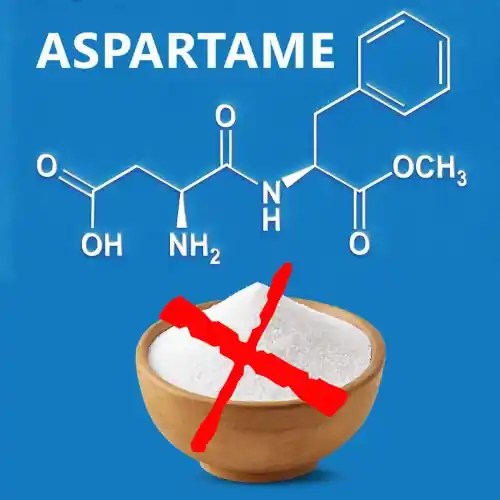
aspartame molecule and bowl
Aspartame poses risks. A. Whittall

Aspartame: the sweetener

What is it?

Aspartame is an artificial food sweetener, synthesized from two aminoacides, aspartic acid and L-phenylalanine, which are reacted in a process involving acetic acid and a palladium catalyst. The final product is a chemical known as L-aspartyl-L-phenylalanine methyl ester. The image above shows its molecular formula.

Apartame was a chance discovery that happened sixty-years ago, when James M. Schlatter, seeking a drug to prevent ulcers, stumbled apon this product which is nearly 200 times sweeter than sugar (sucrose).

It has almost zero calories which makes it an ideal artificial sweetener. However, since it is unstable when heated, losing its sweetening properties, it is only used in products that are not baked such as sodas, powdered fruit juices, gelatin, yougurt, sugar-free syrups, chewing gum, etc.

Some brand names for Aspartame are Nutrasweet®, Equal®, Canderel®, and Sugar Twin®
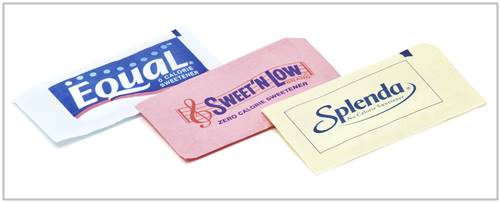
three sweetener packets: Splenda, Equal, Sweet’N Low
Artificial Sweeteners entail some health risks

As it contains phenylalanine it should be labeled as not suitalbe for people with phenylketonuria (PKU), a genetic disorder that causes difficulty in metabolizing phenylalanine.

Maximum Daily Allowance

The limits set in the European Union by the European Safety Authority (EFSA) are 40 milligrams per kilogram of body weight (mg/kg). In America, the U.S. Food and Drug Administration (FDA) has set a slightly higher value, which is 50 mg/kg. The World Health Organization set the dose at 40 mg/kg.

Doses below the Maximum Recommended Dose can be harmful

The study that we mention further down administered doses well below the Maximum Daily Allowance, and even so, found harmful effects.

Aspartame: Cognitive and Cardiac Side Effects

The paper noted the wide use of aspartame as a sweetener to replace sugar and reduce its intake. It is consumed by those trying to manage their weight. The authors wanted to investigate the long term effects of an intermittent intake of aspartame at levels below the maximum allowed doses recommended by health authorities.

The paper found that aspartame decreased appetite and also body weight "owing principally to a 20 % reduction in fat deposits." It also found that it caused a mild enlargement of the heart (mild cardiac hypertrophy) and altered the memory and cognitive abilities of the mice that consumed it.

Since most studies have been short-term, they implemented a 52-week long-term study and administered a "human equivalent dose (HED) averaging 7 mg/kg body weight per day, well below recommended maximum of 50 mg/kg/day."

It compared mice consuming this dose of aspartame in an intermittent manner (3 days every 2 weeks) and compared them with a control group. The study was designed to mimic human consumptio patterns.

...the study demonstrates that long-term exposure to artificial sweeteners can have a detrimental impact on organ function even at low doses, which suggests that current consumption guidelines should be critically re-examined. Irati Aiestaran-Zelaia, et al. (2025)(1)

Main Findings

  • Suppressed appetite, and loss of body fat (20% reduction)
  • The intermittent intake of aspartame lowered the weight of the subjects and also their body temperatures, albeit slightly.
  • Blood sugar: no effect. "aspartame did not significantly affect blood glucose or insulin metabolism."
  • Heart: impaired function (more details below)
  • Brain: reduced cognitive function (see below)

Weight Loss: Less appetite and lower body fat

At least in this study (there have been different outcomes in different studies regarding the weight loss effect of aspartame in mice), "the findings strongly suggest that aspartame depresses appetite and reduces body fat in adult mice." It led to a significant 20% drop in body fat.

Negative effects to the heart

The wall that separates the left and right sides of the heart, known as septal wall, was flattened in aspartame-treated mice, which experienced a 25% decrease in septal curvature. They also experienced a 45% increase in the blood retained in their right ventricle after their hearts contracted meaning that less oxygen-poor blood gets pumped to the lungs to replenish oxygen levels. The output of both Left and Right ventricles was reduced by 26% and 20%, respectively (the left ventricle pumps the oxygenated blood to the entire body).

This retention could be the reason the septum is flattened, and as the authors state: "chronic aspartame-induced cardiac stress... further suggesting impaired cardiac function as a result of chronic aspartame exposure... Thus, aspartame appears to induce structural changes in the heart and to impair its performance."

The analysis at the end of the trial revealed mild hypertrophy (enlargement) along with fibrosis (scarring) and the presence of pro-inflammatory cells, which can cause damage to the heart.

Brain: Cognitive Impairement

The study reported that "Aspartame alters glucose uptake in the brain and may impair cognitive function." It noticed that initially, aspartame increased the brain's demand of glucose by a factor of two, glucose is an important source of energy for the brain. However, after 10 months, the mice who were not consuming aspartame overtook those on the intermittent-aspartame diet: "glucose uptake was higher in the control mice, reaching approximately ∼ 1.5-times more than in the aspartame-treated animals." This variation in the uptake of glucose could have a negative impact on the brain's normal functioning.

The mice were subjected to the classic Barnes Maze test, where their cognitive abilities were assessed, "Aspartame treated mice display behavior suggestive of reduced spatial learning and memory capacity."

References and Further Reading

(1) Irati Aiestaran-Zelaia, et al. (2025), Aspartame decreases fat deposits in mice at a cost of mild cardiac hypertrophy and reduced cognitive performance. Biomedicine & Pharmacotherapy, Vol. 194, 2026, 118891, ISSN 0753-3322, https://doi.org/10.1016/j.biopha.2025.118891.

About this Article

Aspartame could be bad for your brain and heart, A. Whittall

©2025 Fit-and-Well.com. First Published: 26.Dec.2025. Update scheduled for 26.Dec.2028. https://www.fit-and-well.com/fitness/aspartame-bad-for-brain-and-heart.html

Tags: sweeteners, aspartame, heart, cognition, health, diet, weight, sugar
More Articles: Read on

jar with spilled nuts text says Fiber

Fiber: fact sheet

Dietary fiber: what is it? Types: Soluble, Insoluble. Sources, RDA, benefits and risks, health-promoting effects. Are Inulin & fiber supplements effective?

More...

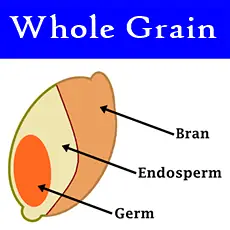
whole grain

Health Benefits of Whole Grain

Whole grain protects against cardiovascular disease, diabetes, cancer, and obesity. Replacing refined grain for whole grain in your diet will make you healthier.

More...

honey

Honey uses, benefits & risks

Honey is a healthy and natural food used as a sweetener since antiquity. It also contains phytochemicals such as phenolic compounds that give it antioxidant, antimicrobial, and anti-inflammatory properties.

More...

Health Advice and Advertisements Disclaimer

The material appearing on Fit-and-Well.com is for educational use only. It should not be used as a substitute for professional medical advice, diagnosis, or treatment.

We do not endorse products or services that are advertised on the web site. Advertisers and advertisements that appear on this website are served by a third party advertising company.

Share

Our Social Media

visit our Facebook click to send us an e-mail visit our blog follow us on Instagram

Policies

Terms & Conditions

Privacy Policy

Affiliate Disclosure

Advertisement Policy

Don't Sell my Personal Information

Cookie Policy

Publishing Ethics

Editorial Guidelines

Medical Disclaimer

About

About Us

Contact Us

Accessibility

Site Map

Patagonia Wellness
Liniers 440, B1602 Florida, Buenos Aires, Argentina

E-mail: info@fit-and-well.com

Copyright © 2018 - 2025 Patagonia Wellness. All rights reserved.

Fit and Well: Health, Fitness, Diet & Food information website
Our website is a reliable source of up-to-date, scientifically proven information on health, fitness, wellbeing, diet, food, and nutrition.
Our mission: Educate and inspire with reflective evidence-based reasoning. Information and News that you can trust.

Last updated V.1