Cervical Health Awareness Month: Cancer Prevention
Screenings and Vaccination

Fact Checked
×All the content published in our website is fact checked to validate its accuracy.
Visit our guidelines web page to learn more about our strict processes regarding how we review our content's sources: reliable and reputable journals, media websites, universities, colleges, organizations, and professionals.
Our articles are based on scientific evidence, and the references are included in its footnotes, which are clickable links to sound scientific papers.
First published: 07. Jan.2026
Overview
The National Cervical Cancer Coalition of the U.S., and the American Social Health Association have designated January as the Cervical Health Awareness Month.
HPV is the major cause of cervical cancer, which in turn is one of the most common cancers in women.
The goal of the cervical health awareness month is to create awareness about cervical cancer, and encourage women to learn how to prevent the disease: regular screenings for cervical cancer and the virus that causes it (human papillomavirus or HPV), as well as vaccination against HPV. (1)
In this Article (Index)
Cervical Cancer
Cervical cancer affects the cells in the cervix, and its main cause is Human Papillomavirus (HPV) infection. It can be prevented with the HPV vaccine, and regular screening, such as Pap tests and HPV tests, can help detect any malignant cells at an early stage. Initially, the disease is symptom-free, but at later stages it may cause abnormal vaginal bleeding, unusual discharge, and pelvic pain. (2)
Treatment ranges from surgery in early stages to radiation therapy or chemotherapy for advanced cancer.
- Cervical cancer is one of the most preventable and treatable forms of cancer.
- However, it still is one of the most common causes of death for women.
- Cervical cancer is the 4th most common cancer among women.
- Each year, there are an estimated 604,000 new cases and 342,000 deaths.
- Cervical cancer can be cured if diagnosed at an early stage and treated promptly.
Screening
Timely screening can help detect cancer early. Early detection can help reduce the severity of the disease.
Women should receive regular screenings to check the health of their cervixes (The cervix is the narrow, lower part of the uterus that opens into the vagina).
The American Cancer Society has issued the following screening guidelines. (3)
Screening Guidelines
Screening should begin at age 25 and continue to at least age 65.
Testing options.
- A primary HPV test (HPV test alone) on a cervical sample collected by a health care provider every 5 years. (The preferred option).
- A primary HPV test done on a self-collected vaginal sample, every 3 years.
- A co-test (HPV test combined with a Pap test) every 5 years.
- A Pap test alone (if HPV testing isn't available) every 3 years.
Getting screened regularly is the most important thing, no matter which test you get.
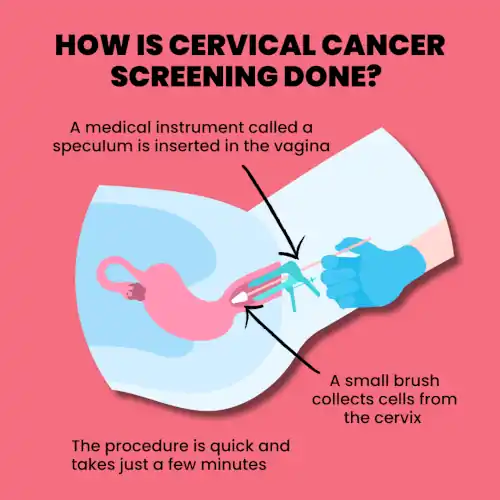
You should get screened even if you have received the HPV vaccine, are in a long-term monogamous relationship, are not sexually active, or are in menopause.
Your healthcare provider may indicate more frequent screening if you are at higher risk for cervical cancer.
At age 65 or older, you can stop screening if you have done it regularly and your last two HPV tests or your last three Pap tests were normal.
In addition to receiving screenings, the Centers for Disease Control and Prevention (CDC) strongly recommends that women (and men) receive HPV vaccinations to stop the spread of the cancer-causing HPV virus.
HPV Vaccine
Screening, early detection, and the Human Papillomavirus (HPV) vaccine are the three tools that help prevent cervical cancer.
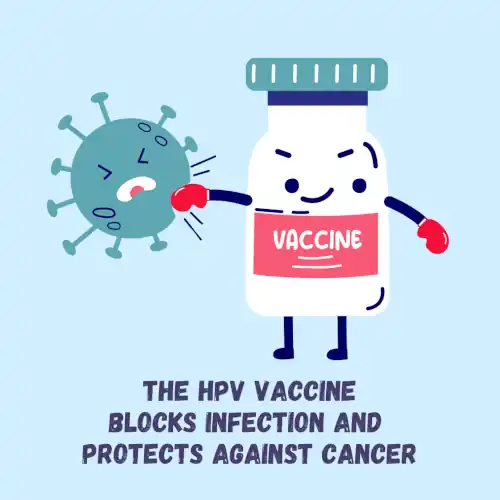
HPV vaccination prevents infection from high-risk cancer-producing variants of HPV, and also the low-risk types that produce genital warts.
HPV not only causes cervical cancer, but it can also lead to anal, vaginal, head and neck, and vulvar cancers. The HPV vaccine can help prevent all of these HPV-related cancers.
The vaccine is effective. Since it was introduced in 2006, HPV types that cause cancer and genital warts have dropped by 88% among teenage girls. For young adult women, the drop is 81%. Australia is aiming at fulfilling the World Health Organization (WHO) goal of erradicating cervical cancer by 2024, 83.4% of girls and 80.6% of boys had received at least one dose of the HPV vaccine. (4)
Starting early provides better protection and fewer doses. The vaccine is approved for all young people (regardless of sex or gender) and can start as early as age 9. It is approved up to age 45.
Early vaccination is best. We can eliminate cervical cancer with widespread early vaccination.
Side Effects
As with any medicine or vaccine, there is always the chance of negative side effects. These can range from moderate reactions to serious ones, such as an allergic reaction (though the latter are rare).
References and Further Reading
(1) The National Cervical Cancer Coalition (NCCC). January is Cervical Health Awareness Month. Accessed 07.Jan.2026
(2) International Gynecologic Cancer Society. Cervical Cancer. Accessed 07.Jan.2026
(3) American Cancer Society, (2025). American Cancer Society Guidelines for the Early Detection of Cancer. December 4, 2025
(4) Australian Department of Health, Disability and Ageing, (2025). Human papillomavirus (HPV) immunisation data. June 5, 2025.
About this Article
Cervical Health Awareness Month: Cancer Prevention, A. Whittall
©2026 Fit-and-Well.com. First Published: 07.Jan.2026. Update scheduled for 07.Jan.2029. https://www.fit-and-well.com/fitness/cervical-health-awareness-month.html